
Stone Walls
Dry Stone
Dry stone walls are made out of stone, and nothing else. No mortar is used to bind them together, only gravity and the craft of stacking them in just the right way.
These structures blend in with the landscape, and can shift and settle as the earth beneath moves over time. Even a badly built dry stone wall can last over 100 years, and built well, they can stand for thousands.
Drains, arches, furniture, stairs, footpaths and buildings as well as the tombs and monasteries of Ireland and the ancient cities of Great Zimbabwe and Machu Picchu have been built of dry stone. Nowadays, it is also used in conservation for flood management and habitat restoration.
It is particularly useful for retaining walls - water can drain freely through, it doesn't crack and doesn't need a damp proof course or weed barrier.
As well as being flexible and long-lasting, dry stone construction has a low carbon footprint and can provide a habitat for plants and animals. We can even plant alpine plants in the wall crevices, or top it with a hedge or grasses.
Mortars - lime and conventional
We also work with mortar. While ordinary 'Portland' cement is useful in the right place, it is important that old structures are repaired with lime mortar. Using local suppliers of lime, we can rebuild and repoint estate walls, garden boundaries and buildings.
We can use local field stones or buy in quarried material, depending on requirements.
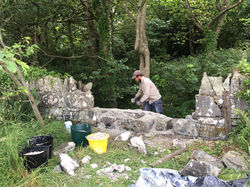 Famine era estate wall, Ards Peninsula |  Re-pointing with lime mortar |  Traditional materials need protection from the elements while curing |
|---|---|---|
 Retaining walls and stone furniture can be built into earth banks |  Brierfield, Lancashire |  A keen apprentice! |
 Hazelbank, Seaforde Estate - Before |  Hazelbank, Seaforde Estate - After |